
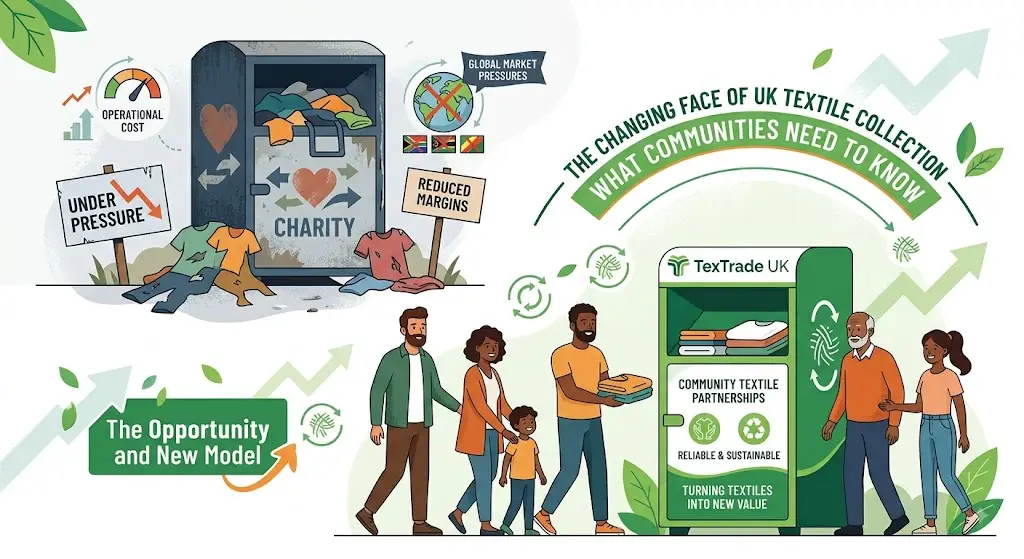
The UK textile collection landscape is shifting. Charities that have dominated used clothing collection for decades are reducing their networks. Textile banks are being removed from supermarket car parks and household waste recycling centres. The price merchants are willing to pay for donated clothing is falling. For councils and community organisations that depend on textile revenue, this is a pressing concern.
Understanding why these changes are happening — and what the alternatives look like — is essential for anyone managing community textile collections in 2026.
What is happening to textile bank networks
The most visible change is the removal of textile banks. In early 2026, Devon County Council shut 27 textile bring sites following changes to the Salvation Army Trading Company (SATCoL) network. SATCoL, the largest charity textile collector in the UK, has been steadily reducing its bank footprint around the country, citing rising operational costs and declining margins on exported clothing.
This is not confined to one operator. Across the sector, textile collection via charity banks has become less economically viable. The reasons are global, but the impact is local: fewer collection points mean fewer opportunities for households to donate, which means more textiles ending up in general waste.
Why prices are falling
The used clothing export market is under sustained pressure. African markets, historically the largest destination for UK second-hand clothing, have introduced import restrictions aimed at protecting domestic textile industries. East African Community members have raised tariffs. Rwanda has banned used clothing imports entirely.
Meanwhile, the quality of clothing entering the donation stream has declined. Fast fashion garments — produced cheaply with synthetic blends — have lower resale value and shorter wearable lifespans. A bale of high-quality cotton and wool garments commands a far higher price than a bale of polyester-mix fast fashion, and the proportion of the latter is growing.
The result is a margin squeeze. Charity collectors who previously generated meaningful revenue from textile banks now face lower prices, higher logistics costs, and stricter quality requirements from export buyers.
The retreat from household waste recycling centres
In late 2025, SATCoL announced it would stop collecting textiles from Household Waste Recycling Centres (HWRCs) altogether. HWRC textiles — exposed to weather, mixed with waste, and often contaminated — yield lower-grade material that is harder to sell. With margins tightening, the charity made the commercial decision to focus on higher-quality donation streams.
Local authorities were left with a gap in service. Some have responded by ending textile collection entirely. Others have sought commercial partners to maintain provision. The lesson is clear: relying on a single operator — particularly one whose business model is under strain — creates risk for councils and communities alike.
What this means for councils and charities
Councils face three immediate challenges:
- Service continuity. When charity partners withdraw, councils must either find an alternative provider or accept reduced textile collection coverage.
- Revenue loss. Textile bank commissions have provided modest but reliable income for some councils. Without replacement agreements, this income disappears.
- Landfill risk. Without convenient collection points, households are more likely to dispose of clothing in general waste bins, increasing landfill volumes and undermining council recycling performance.
For charities, the challenge is different. Many small and medium charities operate their own clothing banks alongside larger operators. As prices fall, the economics of running a clothing bank network become more difficult to sustain without scale.
The commercial alternative
The contraction of charity-led collection does not mean the end of community textile recycling. It means the model is changing. Commercial collectors — companies that specialise in textile collection, sorting and export at scale — are better positioned to absorb market fluctuations and maintain consistent service.
Commercial operators can invest in sorting infrastructure that charity models cannot fund. They can diversify export markets to reduce dependency on any single region. And they can provide the data transparency — tonnage collected, destination reporting, diversion rates — that councils increasingly require for their own performance tracking.
How TexTrade UK supports communities
We operate textile banks and scheduled collection services for councils, charities and community groups across the UK. Our model is built on long-term partnership rather than short-term market opportunity. Every collection point we manage comes with regular servicing, clear reporting and a commitment to keeping textiles out of landfill.
For councils reviewing their textile provision, for charities seeking reliable collection partners, and for community organisations wanting to establish new textile recycling points — we can help. Contact our team to discuss how we can support textile recycling in your community.